14:41 pm, 1 Mar 2022

One element for reform of healthcare services is continuously overlooked: the management systems employed by Hospitals. Leaders in Hospitals work hard on cutting costs and inefficiencies and balancing that with improving patient safety and the quality of care. However, the question remains today in most Hospitals in Malaysia and ASEAN…do the management systems support these objectives?
Does your hospital still operate with good old-fashioned management-by-objective systems? This is where Leadership sets objectives or KPI’s for managers to achieve and managers are judged (fired, demoted or promoted) based on meeting those objectives or KPI’s! Please do not drop that ball!
We can no longer use these old-school ways especially with younger personnel. Newer management systems are built on the simple premise of “respecting the people” i.e. Leadership respects Clinicians and caregivers enough to allow them sufficient control to change processes without managements involvement. This is a Management-By-Process system.
This system is certainly not new but at PULSE we believe Hospitals in Malaysia and ASEAN have found it hard to put effectively into practice. This is because leaders (1) must know exactly how care is delivered to patients, and, (2) lead frontline caregivers in improving those processes daily. This change is quite glaring – Leaders are now expected to lead teams in problem solving using data available.
Unfortunately, Leaders are not trained to facilitate problem solving by those that best know the issues and, they simply do not have the data to support the problem solving. This new role requires a certain level of skill and experience to put into effect. For example, mid-level managers need to be able to teach evidence-based / data-driven problem solving using the plan-do-study-act method.
They also need to be able to effectively train others on the department or unit’s work. And finally, they need to know how to remove any challenges to improvement for the team. The mid-level manager is not in control of everything that happens; she or he, is a facilitator leading change. They need to accept, and be comfortable with this role!
At PULSE, we set out to address this specifically by providing mid-level management with the tools and knowledge they need for a Management-By-Process System. We focused on the method by which data may be collected quickly on mobile phones by all personnel hospital-wide, analysed automatically and reported to mid-level management to facilitate problem solving and to plan-do-study-act. Basically, we developed a Digital Platform that enabled actionable data!
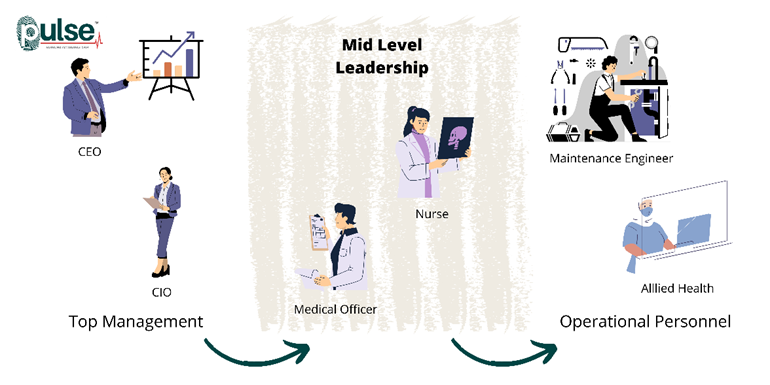
Hospitals that use our PULSE Digital Platform empower mid-level management with the tools and knowledge they need every day on the Hospital operations floor. PULSE is designed to push evidence-based and data-driven decision making to the smallest teams at the frontline. The Platform pushes vital information up and down different levels of the organisation for quicker strategic decisions.
Information is shared daily between mid-level management and other layers of management so everyone understands what is important for each patient, each unit, each department. Leaders may ask simple questions like:
- “What is actually going to deliver a better patient experience?”
- “What does the data tell us?”
- “What action do you think we should take?”
Hospital CEOs today must help middle-level management deal with a systems change and most importantly, the personal change required. Lead your middle management with kindness, mentor them with humility, coach them with passion and teach them with love. Be prepared for brilliant team work, amazing data-driven solutions and a hospital that’s ready for digital transformation.